
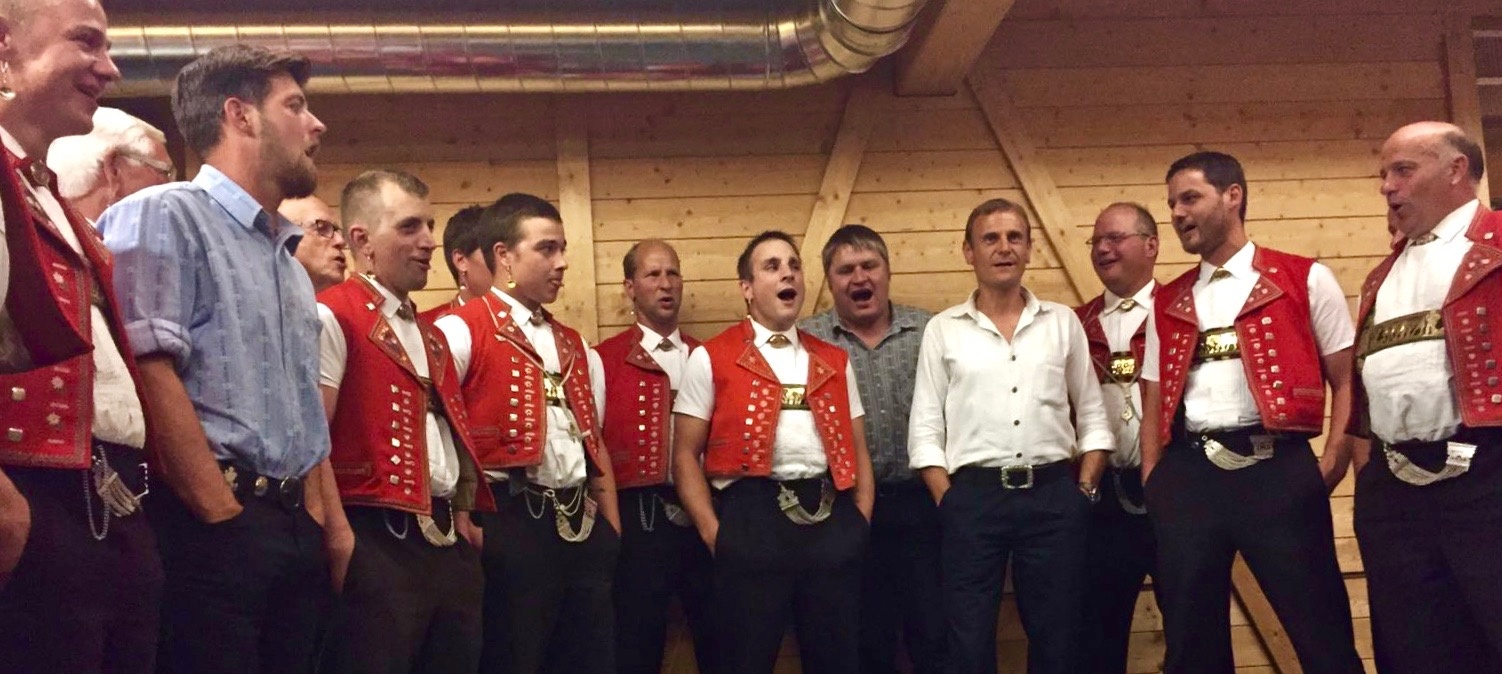
Yodelling in General
The call from mountain to mountain, the communication from alp to alp - these are the origins of yodelling. Love of nature and of home have remained the central themes of this distinctive alpine music, recognisable from its very first notes.
Yodelling is understood to mean singing that alternates between chest and head register on syllables that carry no word meaning. In that sense, yodelling is found all over the world. Above all in mountainous and hard-to-reach regions, natural yodelling forms of communication developed – to make oneself understood from hill to hill, to drive in the cows (cattle calls) or as a means of signalling work commands during logging in the forest. People probably yodelled as far back as the Stone Age, whereas the singing of yodel songs in choirs only arose in the 19th century.
The yodel songs of the natural yodellers
When a solo yodeller begins a slow sequence of notes, other yodellers hum along with the matching note, join in the melody and shape it spontaneously – then we are listening to natural yodel singing. In this original way, yodel songs without words are sung in one to five voices in various mountain regions of Switzerland. In the Muotatal the «Jüüzli» consists of two to three voices, while the Appenzell "Zäuerli" and "Ruggusserli" are multi-part natural yodels that are frequently improvised on the spot. At festivals and on special occasions, multi-part natural yodels are often accompanied by coin swirling in a milk bowl or by the shaking of bells (forged alpine bells). What is special about the natural harmonic series of the natural yodellers is the eleventh note: the natural note, or alphorn fa. In the C major scale this peculiar note sounds neither as an „f“ nor as an „f sharp“, but lies somewhere in between. This „fa“ takes some getting used to for many ears, because since the 18th century, when „well-tempered“ tuning was introduced, the note has all but disappeared from the scales in common use. It is rarely heard any more – together with the neutral third and the seventh – except in the Muotatal, SZ.
Yodelling choirs and yodel songs
In Switzerland and in the other Alpine countries, yodelling developed into song form during the 19th century. The yodel song, now cultivated in two, three and four parts and usually accompanied by a "Schwyzerörgeli" (hand accordion), is the favourite genre of the association yodellers. They joined forces in 1910 in the Swiss Federal Yodelling Association and present themselves to the judges every year at regional and cantonal festivals, and every three years at a federal yodelling festival. The songs are mostly about mountains, nature and home, but also about themes such as freedom and independence. Since 1971, sacred yodel songs have also been heard at yodel masses. There are around 2,000 Swiss yodel song compositions today, mainly in German but also in French. In Italian-speaking and Romansh Switzerland yodelling is not really found (any more), and where it is, the songs sung are likewise predominantly in German.