
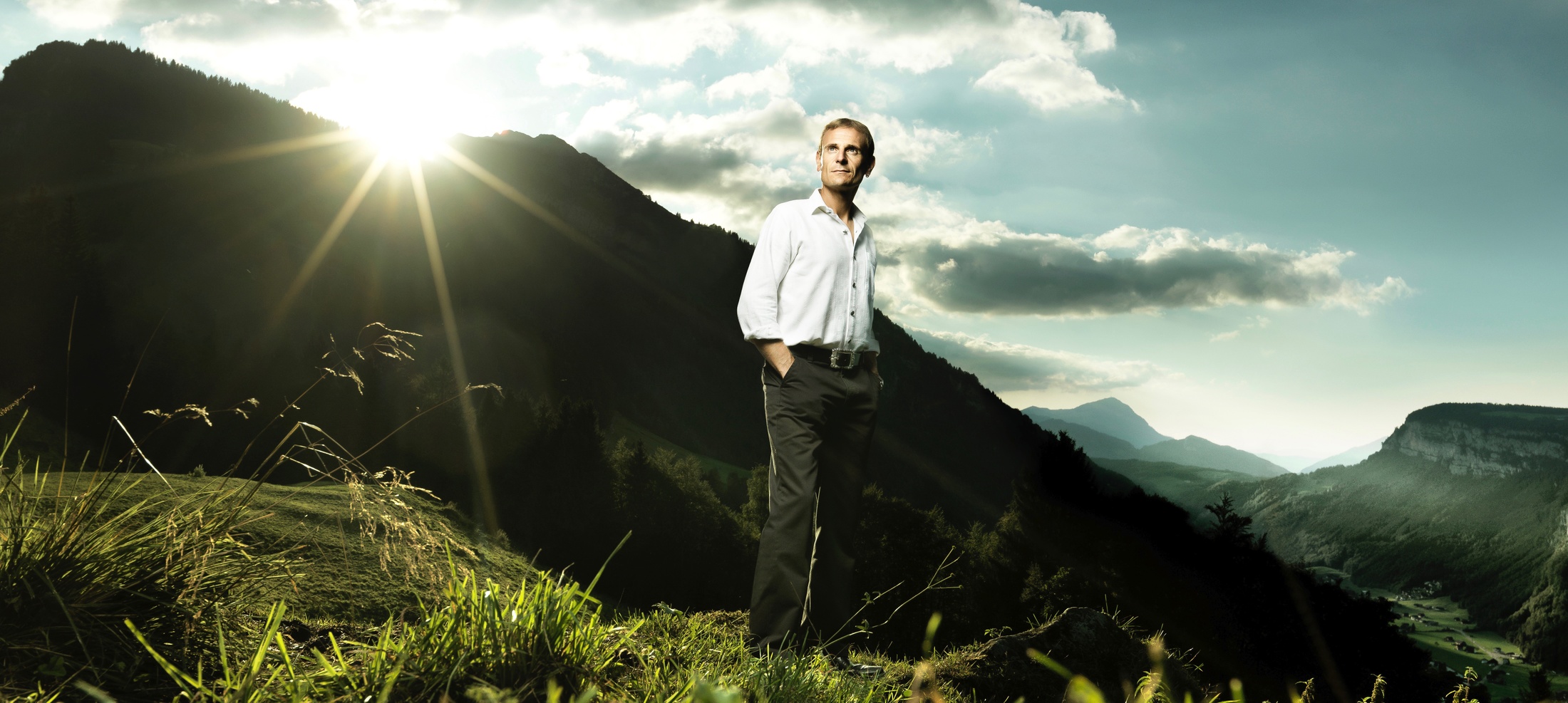
Eleven Questions about the Naturjuuz
Eleven questions about the Naturjuuz put to Bernhard Betschart
(The answers are Bernhard's own entirely personal and non-binding views and experiences.)
Question 1:
What is it that actually makes the Muotathal Naturjuuz so special?
The Muotathal Naturjuuz is a primeval, traditionally handed-down form of what is today the better known "club yodelling". The Naturjuuz is distinguished by its earthy, natural character. What certainly strikes the untrained ear are the "off-kilter" notes of the natural harmonic series. Among them is the alphorn fa that surfaces now and again, and also the neutral intonation of the 3rd and 7th degrees, that is, of the third and the seventh. In part singing this produces intervals that are unfamiliar and, to our ears, dissonant.
Question 2:
In what way does the Muotathal Naturjuuz differ from other "Naturjüüze"?
The Muotathal Naturjuuz is more archaic than in other areas. It can also be said in general that «beautiful» singing is in part deliberately not cultivated; expression and individuality are placed at the centre instead - just as old sound recordings already show. The style is unpolished; the notes are sometimes earthy, sometimes wild. This too is why their Muotathal Jüüzli at first sound angular, raw and at times surprisingly different to the unaccustomed ear.
Question 3:
How did the Naturjuuz actually come about?
Nobody can say that with any precision today. There are people who claim it was a kind of communication between farming folk on the various alps and cattle pastures. Others say these melodies were influenced by the wind and string music heard in the concert halls of Schwyz, Brunnen and so on. But it is certainly one of the most primeval forms of singing in this region.
Question 4:
Can anyone learn the Naturjuuz, or do you have to have it "in your blood"?
You can learn the Naturjuuz if you have a bit of an ear for music, no doubt about it. But using the natural tonalities the way they were practised in the old days - that is not so easy. I of course had it far easier and was fortunate to have grown up with the Naturjuuz. So as a small boy I became familiar, without even noticing, with the various traditional melodies and the natural tonality that goes with them.
Question 5:
Are the individual Naturjüüze remembered purely by learning them by heart, or is there some form of notation for them?
The Jodelklub Muotatal has written down some Naturjüüzli in notation. I myself have written 2 sheet music books based on my two learning CDs, and I know of other people who have written simple Jüüzli down in notation so as to learn them better at workshops and courses. Those of us in the former group "Natur pur", for example, more or less grew up with juuzen and are familiar with these melodies. Or you picked them up and learned them by hearing them from your parents at home, from old tape recordings or when you were out and about.
Question 6:
What was the aim of the Naturjuuz group "Natur pur"?
Beyond appearing in public at concerts and cultural engagements, the real interest lay in juuzen straight from the heart among friends - as had always been done - or, as the name suggests, out in the open. There were some very interesting and wonderful experiences at workshops and natural-tone festivals in Switzerland and abroad, where we travelled. Larger projects or longer journeys were not possible for our farmers, though: "suscht müässtid dr Dänl und dr Heinz nu ä Chnächt zuächätuä"…:-)
Question 7:
In yodelling terms, what is actually the difference between "Natur pur" and the Jodelklub Muotatal?
The first thing that comes to mind is warming up the voice. Which would in fact be very good for the voice, but we simply were not as serious about it as a yodelling club... And then, quite plainly, the natural tonality and the melodic line of the individual Jüüze.
With us there was only a small "juuz scheme" that we moved within: one to three voices, two times two parts, the handed-down melody and the personal mood and character of each individual Juuzer. A yodelling club places more value on uniformity and on fitting the prescribed scheme. In a club there are of course far more voices that have to harmonise with one another. So more discipline is needed there too.
Question 8:
Do you think the Naturjuuz is facing extinction, or is there enough young talent to keep this heritage alive in the future?
Interest in the natural Naturjuuz is, I believe, greater than it has ever been. But I am not talking about us here in the Muotathal; I mean the natural-tone festivals, workshops, yodelling symposia and so on. The distinctive character of the Naturjuuz was recognised many decades ago, for instance by the ethnomusicologists Wolfgang Sichardt, Hugo Zemp and Cyrill Schläpfer.
As for the Muotathalers themselves, I think the interest is still there. The Naturjuuz is still cultivated today by various Juuzer and yodelling clubs, but there are fewer and fewer families who still keep the Naturjuuz alive at home in its spontaneous naturalness. The way it used to be at our house, or at "ds'Guggelers or ds'Fluehöflers etc".
Question 9:
Does the Naturjuuz actually exist on every continent?
On every continent and in every country there is some primeval, natural form of singing and music-making, or, as we say in the Muotathal: '"Juuzen". It just sounds quite different in places, with other vocal techniques, rhythms and melodies. But they are often still natural in tonality and, to our "trained" ear, dissonant and unfamiliar. Just like the Naturjuuz in its primeval way.
Question 10:
Is the Naturjuuz actually protected, the way so much is these days as "cultural heritage"?
Swiss yodelling is currently the subject of an application for UNESCO World Heritage status. The wonderful, dialect-bound characteristics of the various yodelling regions can, however, mostly only be cultivated and carried on by the people who live there and by friends of yodelling.
Question 11:
Your Naturjuuz group "Natur pur" was an all-male affair? Coincidence, or deliberate?
Erm... yes, women just do not have an easy time of it with us... No, joking aside. In the Muotathal / Illgau there have always been men and women who juuzt. In the old days it was quite evenly balanced with us, and it was only through male choirs, and later yodelling clubs, that it grew into a "male dominance". When I think of the people who come to my workshops, so far they have clearly been mostly women who show an interest in the Naturjuuz and in learning more about it.
For me it makes no difference whether a man or a woman juuzt, because in our family at home there were more "Meitli" than "Buäbä". So in my younger years I did a lot of juuzen with my sisters and my parents, which was wonderful.